Proving a negotiation attempt through an ADR evidence (known in Spain as a MASC (Medios Adecuados de Solución de Controversia) before filing a civil lawsuit has been a major headache for lawyers and solicitors since the entry into force of the Organic Law 1/2025 on measures for the efficiency of the public justice service.
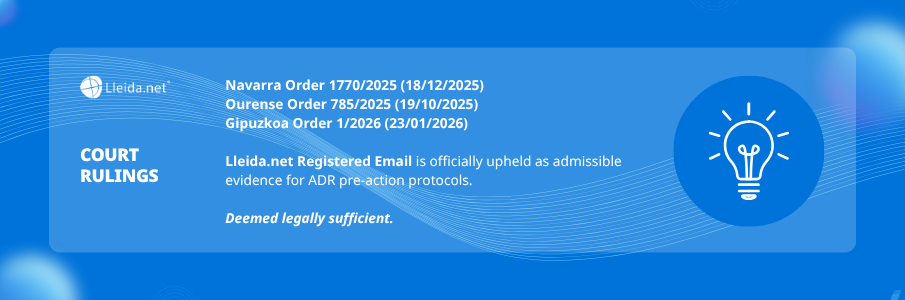
Now, almost a year into its application, the provincial courts of Navarra, Ourense and Gipuzkoa have issued resolutions expressly recognising that the Registered email from Lleida.net is a valid and sufficient means to meet the procedural requirement demanded by the law.
Table of contents
What are ADR evidence and what types does the Organic Law 1/2025 recognise?
The law establishes the obligation to attempt an ADR before going to court, but what exactly are they, and what options does the regulation provide?
ADR are out of court alternatives for resolving conflicts in a more agile, collaborative way adapted to the needs of the parties, avoiding or at least trying to avoid direct recourse to judicial channels.
Typologies
The law refers to six typologies, although it makes clear that it is not a closed list: any negotiating activity recognised in other state or regional laws is also valid.
Mediation: a process facilitated by a neutral third party who helps the parties reach an agreement.
Direct or assisted negotiation: between the parties themselves or through their lawyers.
Independent expert opinion: a non-binding technical report that guides the resolution of the conflict.
Collaborative law process: with lawyers specifically accredited for this type of procedure.
Conciliation: in its public modality (before a notary, registrar, lawyer of the administration of justice or justice of the peace) or private.
Confidential binding offer: a formal proposal with legal effects between the parties.
How to prove an ADR before the court?
It is not enough to try it; you must be able to prove it. The regulation stipulates that the documentation provided must evidence:
The negotiating activity in an exhaustive manner, including attempts to activate the ADR in cases where the opposing party refuses to participate actively.
That the other party received the request or proposal, regardless of whether they decided to respond or not.
The date of receipt of the invitation to participate in the negotiating process, as well as the possibility of accessing the full content of said invitation or proposal.
In practice, this means that the medium used in mediation attempts must leave a solid documentary trail, with sufficient evidentiary value to be presented before the court.
The Registered email from Lleida.net as a solution
To avoid the risk of the lawsuit being dismissed, more and more lawyers are turning to the Registered email from Lleida.net as an effective and legally accepted tool to evidence compliance with the procedural requirement demanded by the Organic Law 1/2025 before starting judicial proceedings.
The registered email from Lleida.net is a reliable means of communication that has full admissibility as evidence in judicial proceedings because it proves simultaneously:
The identification of the offeror, leaving a record of who made the communication.
The effective receipt of the request or invitation to participate in the negotiating process.
The exact date of delivery, preserving the confidentiality of the content at all times.
Non repudiation, through the certificate of evidence with a time stamp issued by Lleida.net as a qualified trust service provider.
Expert Insight: Our Compliance team breaks down the technicalities of court-admissible digital evidence in this video.
In addition to registered email, Lleida.net offers other technological solutions that facilitate the exchange of communications, the collection of information, the proof of access or denial of content and the signing of documents with full legal value throughout the negotiating process.
Three judicial resolutions that endorse the Registered email from Lleida.net
The registered email from Lleida.net already has express judicial support to demonstrate compliance with the ADR evidence procedural requirement under Organic Law 1/2025. It is not doctrine or interpretation; it is a resolution issued in the second instance by different provincial courts, which equate it to a reliable medium analogous to a burofax.
The three cases conclude that it is sufficient, as the system:
Proves the sending of the communication.
Guarantees the full content sent. Identifies the sender.
Allows proving effective receipt.
Determines the certain date of delivery.
The result: valid compliance with Article 17 of the Organic Law 1/2025 and its seventh additional provision, focusing judicial control on the sufficiency of evidence and not on the physical support used.
When an unregistered email falls short for ADR evidence
Recent case law also sends a warning message to those who try to prove an ADR with a conventional email: it is not enough.
The provincial courts of Zaragoza and Granada have dismissed lawsuits in which the ADR attempt was proven only with a traditional email, without registration or guarantee of receipt:
AAP Zaragoza 2500/2025, of 19 November 2025 The court rejected the simple email for lacking reliable acknowledgement, traceability and the intervention of a qualified trust provider. The ADR attempt was not considered valid.
AAP Granada 379/2025, of 10 October 2025 The chamber confirmed that receipt of an unregistered email cannot be presumed and that, consequently, the negotiation attempt became ineffective for procedural purposes.
The difference between admitting a lawsuit or not can lie in a single detail: whether the medium used to communicate the ADR leaves a reliable evidentiary trail. The registered email from Lleida.net is designed precisely so that this trail exists and is recognised by the courts.
How to use the Registered email from Lleida.net to prove an ADR?
Proving the negotiation attempt through an ADR with the registered email from Lleida.net does not require installing any application, nor changing your usual email manager, nor learning any new tool.
The process is as simple as sending an email:
Draft your email with the request or invitation to the negotiating process from your usual account (Gmail, Outlook or any other email service).
Add the Lleida.net registration address in the CC field. That is all.
Lleida.net registers and certifies the sending automatically, generating a document of evidence ready to be presented before any court as reliable proof.
How much does it cost? Lleida.net works with a system of flexible credits: for just €1, you can send your first registered email. No permanence, no contract, no surprises; you pay only for what you use.
Furthermore, if you are a new user, Lleida.net has an introductory package for €9.99 so you can start registering your communications from the very first moment.
Join now, add credits, and start sending Registered emails in minutes.
FAQ: frequently asked questions on how to prove a negotiation attempt through an ADR
What is the difference between a burofax and a registered email to prove an ADR?
Both are valid, reliable means to prove an ADR. The main difference is practical: registered post is more expensive, slower, and requires the recipient to be present for delivery. The registered email from Lleida.net is sent in seconds, costs less (~€1), and generates a document of evidence immediately.
What happens if I do not prove the ADR before filing the lawsuit?
If the negotiation attempt through ADR is not proven, the court may dismiss the lawsuit for non-compliance with the procedural requirements established by Organic Law 1/2025. This means that the judicial process does not even start, with the consequent cost in time and resources. Proof is not optional; it is a prerequisite for accessing judicial channels.
Is the ADR compulsory in all civil proceedings?
Not in all of them. The Organic Law 1/2025 establishes the obligation to make an ADR attempt in general for civil and commercial proceedings, but it provides exceptions. Processes affecting non-disposable rights, voluntary jurisdiction procedures, cases of urgency, and those where there is a situation of violence are excluded.
What requirements must the medium used to prove the ADR meet according to the Organic Law 1/2025?
The Organic Law 1/2025, in its Article 17 and seventh additional provision, requires that the medium used allows proving reliably: the identity of the sender, that the communication was effectively sent, that the other party had the possibility of accessing its full content, and the certain date of delivery. The medium must have sufficient technical and legal guarantees, which excludes conventional email and requires the use of a qualified trust service provider such as Lleida.net.
Is the registered email valid if the other party does not open the message?
Yes. What the law requires is not that the other party read the message, but that they have had the opportunity to access its content. The registered email from Lleida.net proves effective delivery to the recipient’s inbox, which is sufficient to meet the procedural requirement, even if the other party decides not to open the email or respond.
See it in action. Download our Whitepaper and find out how to support your ADR with legally recognised proof.
Utilizamos cookies para optimizar nuestro sitio web y nuestro servicio.
Funcional
Always active
El almacenamiento o acceso técnico es estrictamente necesario para el propósito legítimo de permitir el uso de un servicio específico explícitamente solicitado por el abonado o usuario, o con el único propósito de llevar a cabo la transmisión de una comunicación a través de una red de comunicaciones electrónicas.
Preferencias
El almacenamiento o acceso técnico es necesario para la finalidad legítima de almacenar preferencias no solicitadas por el abonado o usuario.
Estadísticas
El almacenamiento o acceso técnico que es utilizado exclusivamente con fines estadísticos. El almacenamiento o acceso técnico que se utiliza exclusivamente con fines estadísticos anónimos. Sin un requerimiento, el cumplimiento voluntario por parte de tu proveedor de servicios de Internet, o los registros adicionales de un tercero, la información almacenada o recuperada sólo para este propósito no se puede utilizar para identificarte.
Mercadeo
El almacenamiento o acceso técnico es necesario para crear perfiles de usuario para enviar publicidad, o para rastrear al usuario en una web o en varias web con fines de marketing similares.
Utilizamos cookies para optimizar nuestro sitio web y nuestro servicio.
Funcional
Always active
El almacenamiento o acceso técnico es estrictamente necesario para el propósito legítimo de permitir el uso de un servicio específico explícitamente solicitado por el abonado o usuario, o con el único propósito de llevar a cabo la transmisión de una comunicación a través de una red de comunicaciones electrónicas.
Preferencias
El almacenamiento o acceso técnico es necesario para la finalidad legítima de almacenar preferencias no solicitadas por el abonado o usuario.
Estadísticas
El almacenamiento o acceso técnico que es utilizado exclusivamente con fines estadísticos. El almacenamiento o acceso técnico que se utiliza exclusivamente con fines estadísticos anónimos. Sin un requerimiento, el cumplimiento voluntario por parte de tu proveedor de servicios de Internet, o los registros adicionales de un tercero, la información almacenada o recuperada sólo para este propósito no se puede utilizar para identificarte.
Mercadeo
El almacenamiento o acceso técnico es necesario para crear perfiles de usuario para enviar publicidad, o para rastrear al usuario en una web o en varias web con fines de marketing similares.