On 12 June, a critical change affected energy sales in Spain operations under the General Regulation on Electricity Supply (RD 88/2026). The articles regulating how consumer consent must be requested, captured, and verified before any telephone sales contract are now legally enforceable.
For international companies managing clients, expats, or corporate entities residing in Spain, adapting to new energy sales in Spain frameworks marks a major operational shift. The ultimate goal of the regulation is to put a definitive stop to unsolicited and abusive outbound marketing calls within the Spanish territory.
In this new regulatory landscape, non-compliance is no longer just a matter of customer annoyance; it is a severe legal risk. If a commercial call is made without meeting the strict criteria for energy sales in Spain, or if the consumer is misinformed about tariffs or terms, the resulting contract can be declared null and void under Spanish law.
This creates a brand-new operational environment, further reinforced by Spain’s well-known Customer Service Act (Ley SAC). Together, these regulations aim to protect consumers and eradicate aggressive sales tactics. As a result, companies involved in energy sales in Spain channels, regardless of where their headquarters are based, must fundamentally rethink how they engage with local prospects to build sustainable, trust-based relationships.
This is precisely where Lleida.net trust services come into play. Every single step of the process, every communication, every agreement, and every sign-off now needs to be recorded, securely stored, and irrefutably certified as if prepared for a court of law. The era of mere data accumulation is over; we are now firmly in the era of digital evidence.
Table of contents
What the Regulation Demands: Proving prior consent in energy sales in Spain
RD 88/2026 is built upon a premise that completely flips traditional outbound marketing strategies on their head: companies managing energy sales in Spain no longer choose whom to call; consumers in Spain choose whether they want to be called. The regulation strictly prohibits unsolicited telephone marketing and contracting directed at individuals within the country, allowing only two strict exceptions:
- A prior, express, unambiguous, and informed request from the user for a specific, defined purpose.
- When the consumer initiates the call themselves.
Gathering express consent has evolved from an industry best practice to a strict legal obligation, with rigorous validity requirements for energy sales in Spain. Consent must stem from a direct, conscious action by the user, free from intermediaries or external incentives unrelated to the energy supply itself. Furthermore, once the call is underway, it must be recorded in its entirety, the consumer must be clearly informed of how and where to file complaints, and they must explicitly authorise the recording from start to finish.
The Legal Evidence Required for Energy Sales in Spain Compliance
Requesting consent correctly is only half the battle; the other half is proving it. Crucially, under Spanish law, the burden of proof rests entirely on the company driving the energy sales campaign in Spain, never on the consumer.
The Regulation is highly specific about the documentation required for energy sales compliance in Spain, which must be retained in a durable medium when dealing with individual consumers. According to Article 13.ah).1.º of RD 88/2026, the digital trail required to prove valid consent includes:
- User Identification Data: Unless the user signs the contract using a qualified digital certificate or confirms the transaction via electronic means certified by a trusted third party.
- Proof of Pre-Contractual Disclosure: Irrefutable evidence of the exact time the offer summary document was sent to the consumer or, if not delivered in writing, the exact moment it was read by them.
- The Completed and Signed Contract: Executed by the consumer.
- The Full Call Recording: When a contract is executed over the phone, the complete audio recording must be securely stored and made readily available to the consumer upon request.
From a legal perspective, the shift is absolute. It is no longer enough to simply inform the consumer. The regulations demand a robust, traceable, and verifiable chain of custody, a complete audit trail that records every interaction and validates consent before any sales contact occurs.
How Lleida.net Makes It Simple: One Process, One Provider for International Operations
As an EU-Qualified Trust Service Provider, Lleida.net has spent years certifying the very processes that RD 88/2026 now requires. We help international companies manage secure energy sales in Spain through compliant onboarding and contracting workflows that protect the business without adding friction to the customer journey. Everything is documented and verifiable from the outset, so compliance teams don’t have to piece together evidence whenever a local dispute arises.
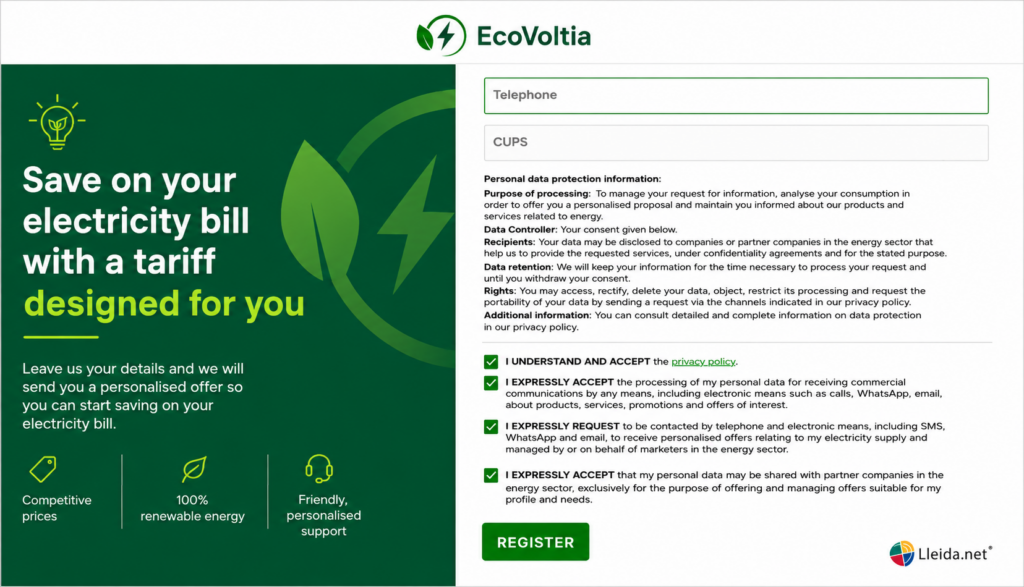
For energy providers, we’ve made implementation straightforward: a fully customizable, easy-to-deploy landing page where consumers can enter their details, accept the relevant terms and conditions, and provide their consent. It fits seamlessly into the customer journey while ensuring every interaction is properly documented and certified.
Here’s how the process works, step by step:
1. Inbound Intent: The consumer completes a form on the energy provider’s landing page, entering their personal details and phone number to request a callback. They accept the relevant terms and conditions and confirm their consent by entering a one-time PIN sent via SMS. The entire interaction is certified and timestamped from the very first click, providing verifiable proof that the consumer initiated the process themselves, as required by law.
Here’s what the landing page looks like in practice:
- Instant Registered Delivery: The offer summary document is dispatched either during the call or immediately after via Registered SMS or Registered Email. This generates irrefutable proof of sending, delivery, and, if the customer clicks the link, the exact moment it was read. This single, automated step fulfils the Spanish disclosure requirement without relying on sales agents to manually log data into a CRM.
- Seamless Digital Execution: Both consent confirmation and contract execution are captured via Click & Sign, our advanced electronic signature solution. All metadata and digital evidence (date, time, IP address, device details, and signer actions) are linked to a single, tamper-proof certificate. The customer approves everything directly from the SMS or email link they received, no downloads or external portals required.
- Enhanced Security: When a more robust identity verification is required, especially for international users, corporate signers, or expats living in Spain, the onboarding process seamlessly integrates with eKYC Video, our secure video-identification tool.
Every stage of this workflow is anchored by a Qualified Electronic Timestamp. The date and time of each piece of evidence are not derived from internal company servers but are verified by an EU-qualified trust entity under the strict guidelines of the eIDAS Regulation, making them fully valid across Europe and within Spain.
The final output is not a scattered collection of files spread across different vendors, but a comprehensive, legally binding audit trail securely stored in a single, durable medium. In a single streamlined flow, you have airtight proof that the consumer requested contact, received the required pre-contractual information, verified their identity, and signed the contract.
Why Waiting is a Risk for Your Energy Sales in Spain Strategy
Moving forward, any commercial call placed to prospects in Spain regarding energy sales without an ironclad, verifiable consent process will be deemed an irregular practice, exposing your organisation to severe financial penalties and reputational damage under local regulations. Do not jeopardise your commercial strategy by delaying necessary operational updates for your compliance systems.
If you want to evaluate how to integrate Spanish compliance seamlessly into your existing telephone onboarding channels, let’s talk.