
Compliance with Spain energy regulation RD 88 2026 became mandatory on 12 February 2026.
For electricity suppliers operating in Spain this is not simply a regulatory update. It redefines how commercial relationships must be documented, how customer consent must be captured, and how every interaction must be proven under regulatory scrutiny
The objective of the regulation is clear. Increase transparency. Protect consumers. Modernise the electricity market in line with European energy transition goals.
The operational impact is equally clear.
Suppliers must now rethink communication processes, consent management and documentation systems. Every commercial action must be traceable and defensible.
The central question is no longer whether your organisation complies.It is whether you can prove it.
Without registered digital traceability, exposure to enforcement action is real.
Table of contents
Why Royal Decree 88/2026 matters for the Spanish energy sector
The regulation introduces immediate changes across core commercial operations.
Contractual communication
Suppliers must
- Notify contractual modifications at least 30 days in advance
- Send notifications separately from invoices
- Ensure communications are clear, accessible and transparent
Express consent
- Signed documents and all contracting evidence must be preserved throughout the entire lifecycle
- Full recordings of telephone contracting must be retained
- Signed documents and all contracting evidence must be preserved throughout the entire lifeycle
Supplier switching
Suppliers must
- Ensure full traceability of the switching process
- Respect maximum deadlines of 10 working days
- Complete technical execution within 24 hours
Customer service
Suppliers must provide
- Free customer service channels
- Electronic acknowledgements of receipt
- Documented responses, including formally recorded complaints
Data protection
The regulation reinforces
- Data protection security and confidentiality obligations
- Strict controls regarding access to the Supply Point Information System SIPS
In addition, unsolicited commercial calls to individuals are prohibited. Traditional outbound telesales models must be fundamentally reassessed.
Penalties for non-compliance: real risks for electricity suppliers
Non-compliance is supervised by the Ministry and the CNMC.
Sanctions may include
- Financial penalties of up to 6 million euros
- Formal consumer claims
- Temporary suspension of access to SIPS which may result in operational paralysis
- Reputational damage and loss of market confidence
The most significant risk, however, is evidentiary.
If a supplier cannot demonstrate that a notification was delivered that consent was explicitly granted or that switching deadlines were respected, regulatory exposure increases immediately. Every undocumented interaction becomes a vulnerability during inspection.
How to ensure compliance through registered digital traceability
Compliance under Spain energy regulation RD 88 2026 requires certainty. Electricity suppliers must be able to demonstrate every communication with legally valid evidence.
LLeida.net Registered digital solutions embed proof directly into operational workflows, allowing organisations to document consent, preserve evidence, and maintain full audit readiness without increasing friction.
Registered digital solutions for electricity suppliers
For legally valid contractual communications, including:
- Contract modifications with proof of receipt
- Price revisions with full traceability
- Suspension or reconnection notices
- Any mandatory regulatory communication requiring demonstrable evidence
For urgent notifications requiring proof of delivery and reading such as
- Suspension alerts
- Reconnection confirmations
- Supply change notifications
Electronic signature Click and Sign
Capture express consent with full legal validity across digital telephone or hybrid channels.
Each signature includes:
- Timestamp
- Identity linkage
- Complete process traceability
Electronic custody and traceability
Secure storage and immediate retrieval of evidence for CNMC audits and regulatory inspections. Documentation remains accessible whenever required.
Identity verification and document validation
For onboarding new contracts and sensitive processes:
- eKYC with liveness detection
- Identity document validation
- Enhanced authentication
- Digital certificate verification
- Security begins at the first interaction.
For suppliers managing high volumes or complex commercial flows, tailored automation ensures:
- Traceability at every step
- Reduced operational risk
- Consistent regulatory compliance
In 2026, registered digital evidence is no longer a best practice. It is a compliance requirement and a risk management necessity. Suppliers who adapt early will not only reduce. They will improve operational resilience and strengthen consumer trust.
Practical cases applying the regulation in everyday operations
The following scenarios illustrate how routine processes must evolve after February 2026
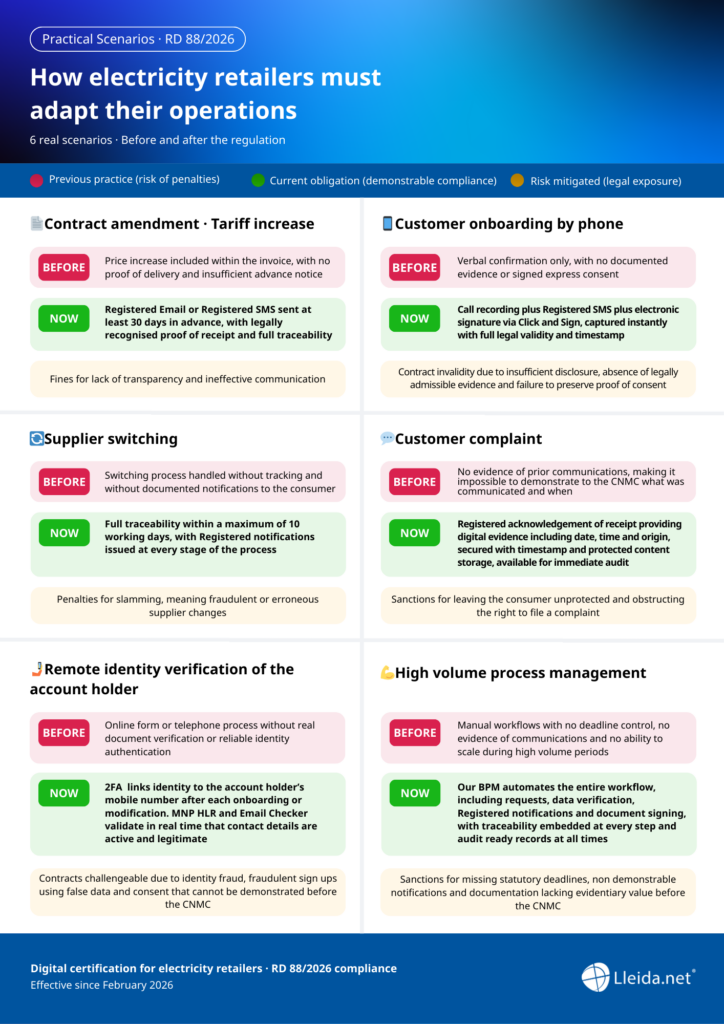
In each case, the common denominator is the same. Move from processes that cannot be demonstrated to registered digital evidence with full legal validity. Registered traceability is not a technical enhancement.It is the difference between compliance and the inability to defend it.
Take the step towards full compliance
Although the regulation requires adaptation, it also creates opportunity.
- More transparent processes
- Stronger consumer confidence
- Automation of critical workflows
- Reduced regulatory exposure
Electricity suppliers that implement registered digital traceability now will transform regulatory pressure into operational strength.
Is your organisation ready for 2026 compliance?